
TDS = DOA's
Unhinged Trump hatred has become cover for the war on public safety


For years, we’ve been told by progressive politicians that every public-safety measure was really just disguised oppression. Border enforcement? Racist. Policing violent criminals? Fascist. Institutionalizing the dangerously mentally ill? Cruel.
And because Donald Trump supported tougher enforcement on all three fronts, the Left decided the opposite had to become their default position.
That’s how Trump Derangement Syndrome evolved from a psychological condition into a governing philosophy. If MAGA says secure the border, the Left demands sanctuary cities. Violent repeat offenders belong in jail? “Decarceration.” The violently psychotic shouldn’t be wandering subway platforms? “You’re criminalizing mental illness!”
The result is a war on safety itself. And the bodies are just collateral damage.

Two cases making national news drive the point home. Last week in New York City, retired teacher Ross Falzone was (allegedly) shoved to his death down a Manhattan subway staircase by a repeat offender who had reportedly been released from psychiatric custody only hours earlier. Authorities say suspect Rhamell Burke had multiple recent arrests and had been taken to Bellevue as an emotionally disturbed person before being turned loose back onto the streets.
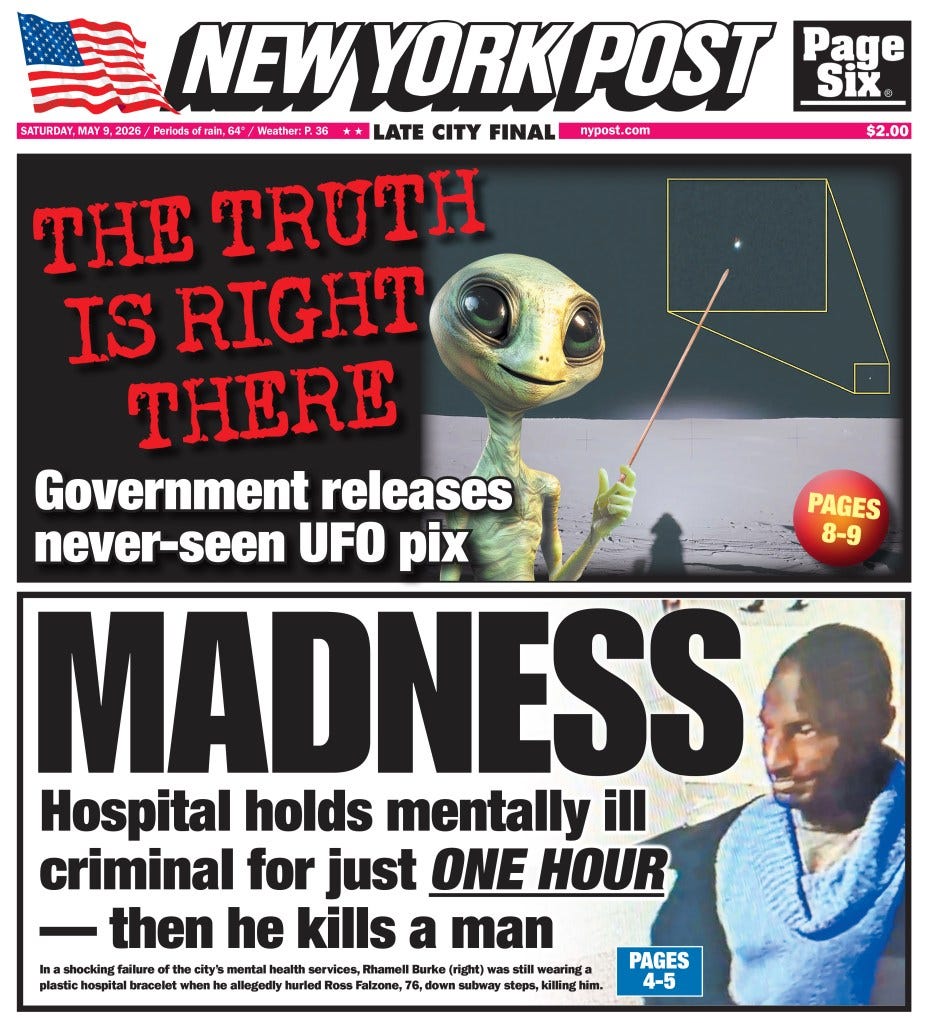
This wasn’t some unforeseeable lightning strike. It was the logical endpoint of an ideology that treats involuntary commitment as oppression — even when dealing with violent, unstable individuals who are plainly incapable of functioning in public.
And as ever: there’s a judge who just let him out (are you exhausted yet?). Meet Judge Marva Brown — she of the “Communities, Not Cages” movement.
She’s a former public defender (of course!) who has a history of letting violent recidivist walk.
Just as telling is the reaction of two fine NYC residents who previously encountered the accused killer here. The male half of the couple fled, leaving his female companion behind to flee Burke on her own. Neither cooperated with police after they arrested Burke, with the female later stating to The NY Post that, “Maybe a part of me was just like, I don’t want to put another black man in jail.”
You’re, like, the problem dear, okay?
If that little scenario doesn’t explain the current state of the NYC electorate, I don’t know what could. Meanwhile, the entity that sits in judgment of police conduct, the Citizens Complaint Review Board, is populated by those who describe cops as “killers” and who subscribe to the current liberal mantra of ACAB (“all cops are bastards”) who see it as their “civic duty” to taunt and abuse them.
“Bastards” like these cops, we guess, who this past week talked a distraught woman off the ledge of a Brooklyn high rise (check the video).
I ask you to take a moment and consider your own line of work, whatever that is. Now imagine your every decision and action will be scrutinized by people who hate you that much.
All the same pathologies are visible in Chicago. The murder of Loyola student Sheridan Gorman allegedly involved an undocumented Venezuelan migrant who federal authorities say had entered the United States illegally, was transported to Chicago by an NGO, committed a crime for which he served no time, and then remained free on the streets, living rent-free in a homeless shelter. He then shot Gorman for no reason (allegedly!).
In this case, we can go to Chicago mayor Brandon Johnson for the telling reaction. Johnson — perhaps the most inept mayor in America (yes, including Karen Bass) — defaulted to the usual platitudes about America having “an incarceration addiction” and an unaddressed “mental health crisis” (from where we sit, the unaddressed mental health crisis is Johnson’s, but whatever).
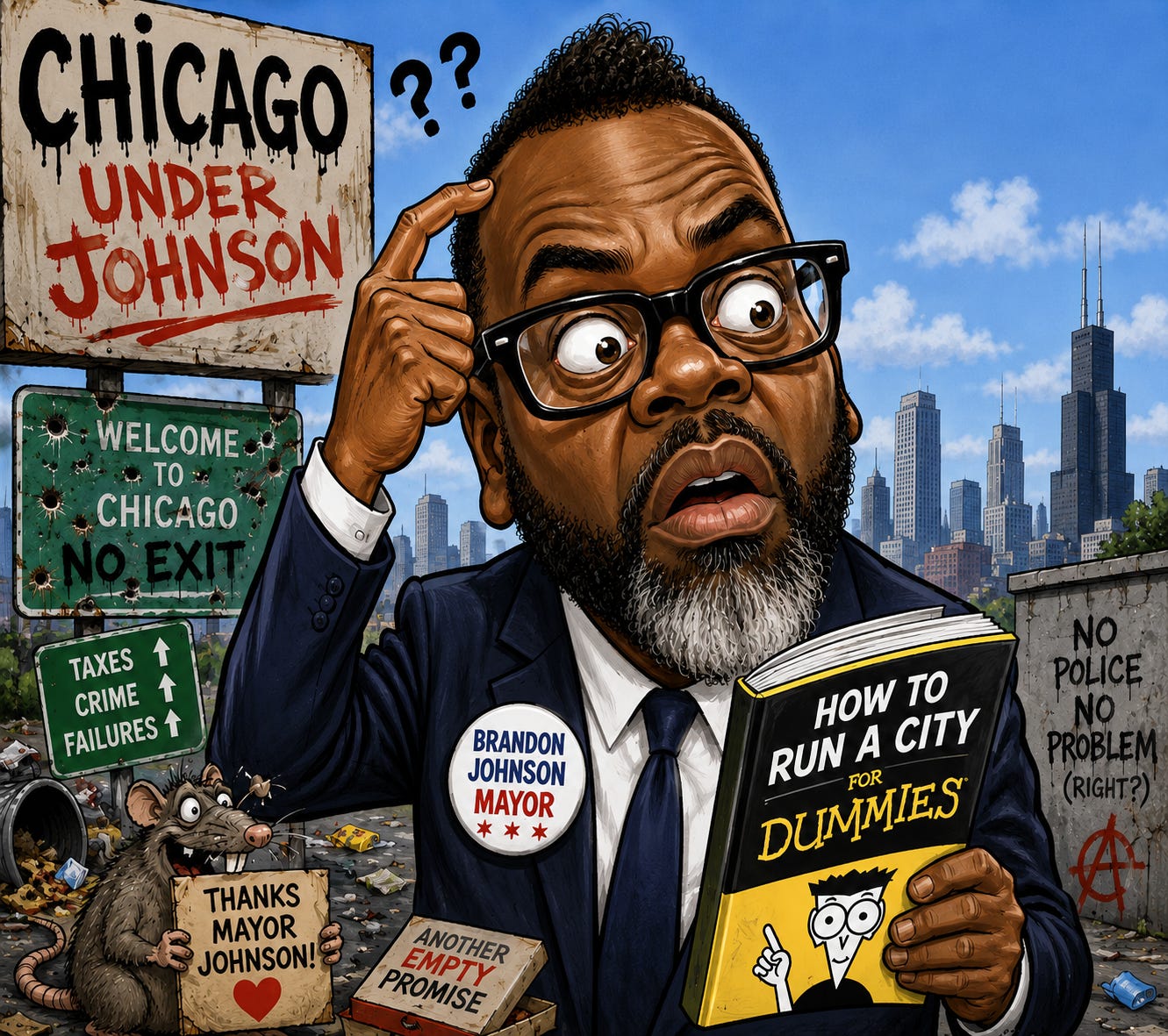
Hey mayor — if there’s this “mental health crisis” out there that needs attention — what’s holding you up? Address it — don’t you run the city? And when you “solve” it, please let mayor Mamdani know. He could use the tip (see Chris’s piece, below).
What’s new and remarkable is how openly many on the Left now reject basic public-order concepts that previous generations of Democrats accepted without hesitation (recall, it was the Dems who passed the landmark 1994 crime bill, sponsored by some guy named Biden). They supported the idea that violent criminals should remain incarcerated. The idea that psychotic repeat offenders should be institutionalized. The idea that nations should control their borders.
None of these were once controversial positions. They became controversial because Donald Trump supported them.
That’s the true damage of Trump Derangement Syndrome. It has driven the American Left into reflexive opposition to common sense itself. Meanwhile, subway riders get shoved onto tracks. College students get murdered. City conditions become menacing and unpredictable. And the political class responds not by restoring order, but by accusing critics of exploiting tragedy.
At some point, Americans will have to decide they’re tired of living inside a graduate seminar on “systems” and “equity” while basic civilization deteriorates around them.
Because most normal people — unlike today’s progressive Democratic party — still believe public safety is the first responsibility of government.
In an election year, we’ll see if the electorate has gotten the message. Because the Democrats clearly haven’t.
The Mental Health System Is… Mental
If the definition of insanity is repeating the same thing over and over while expecting a different outcome… our mental health system is utterly insane.
Once again a New York City resident is dead due to the failure of our mental health system. On May 8th, a deranged career criminal pushed an elderly man down the stairs at the 18th Street subway station. The victim, Ross Falzone, 76, struck his head, broke his spine, and later died from his injuries.
The perpetrator, Rhamell Burke, 32, was no stranger to the police. In fact, the officers who took him to Bellevue earlier that same day were probably still on duty when Burke was released. Cops from the 17th Precinct encountered Burke wielding a stick and acting erratically just outside the stationhouse around 3:30 p.m. After a brief standoff, they transported him to Bellevue for a psychiatric evaluation (notice, by the way: they didn’t shoot him. Sorry to disappoint the CCRB). The evaluation apparently only lasted about an hour, because by 4:40 p.m., Burke was back on the street.
Burke had been arrested four times since February, including for a similar subway attack on April 2. The criminal justice system deemed both his condition and crimes insignificant enough to avoid meaningful action. In the April incident, the victim declined to prosecute. That is an easy excuse for prosecutors, but from experience, hesitant victims can often be persuaded to press charges. It is simply easier to drop the case than to cajole and support a reluctant victim.
It took only about five hours for Burke to travel from the Bellevue psych ward to his tragic encounter with Mr. Falzone at the 18th Street station.
If this story sounds familiar, it should. This is a recurring event in New York City. It is allowed to happen over and over again, often with the same tragic outcome.
Obviously, whatever “evaluation” was conducted at Bellevue was meaningless, or there was a catastrophic error in releasing Burke. The former is more likely — we see this constantly. Seriously mentally ill individuals are repeatedly removed to hospitals by EMS or the police, only to be immediately released because “the system” has no real provision to hold them. And when something goes wrong, the police are often blamed, even though situations like this are beyond their control.
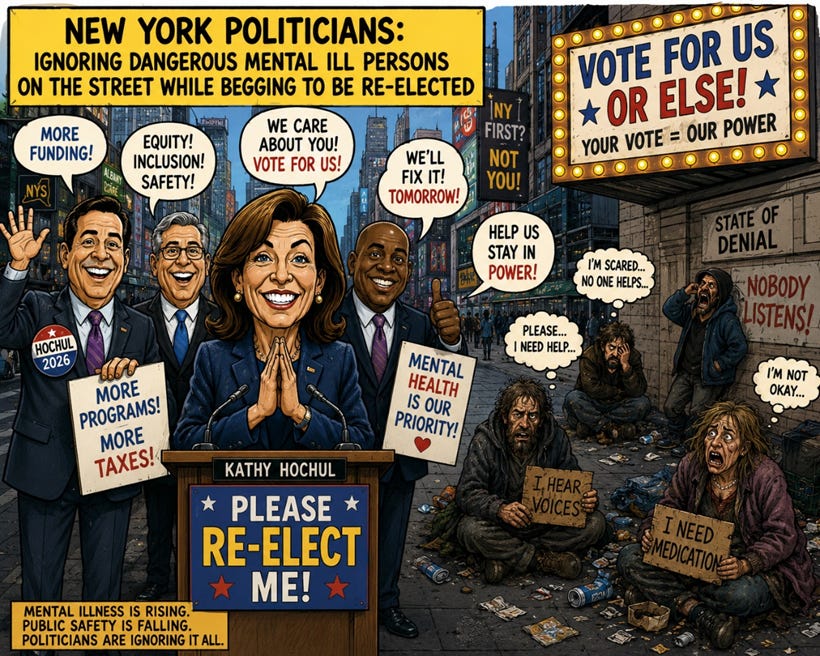
This is ultimately a legal and funding problem that politicians seem unwilling to address. I recently attended a primary debate for a New York congressional seat. There were endless questions about Donald Trump, bike lanes, and pre-school funding. Not one question was asked about revising mental health laws or funding more psychiatric beds. No doubt any such question would have been met with platitudes and stammering.
Politicians do not want to touch this issue because it is difficult. It involves civil liberties, forced medication, involuntary commitment, legal complexities, enormous costs, and potential political blowback. Our political class appears allergic to tough decisions unless constituents force the issue.
Citizens need to demand action. Contact your state and federal representatives. Stronger mental health laws must be enacted. Funding must be allocated for secure hospitals and treatment beds. The criminal justice system must be better integrated with mental health services. And voters must stop electing candidates who offer no new ideas and no willingness to confront this critical issue.
Gerrymandering Our Way To Chaos
No issue exposes the double-speak of politicians on both sides of the aisle more clearly than gerrymandering. Both parties decry it, and both parties do it.
Gerrymandering dates back to the early days of the Republic. In 1812, Declaration of Independence signer and then-Massachusetts Governor Elbridge Gerry signed a bill creating a bizarrely shaped state senate district designed to benefit the Democratic-Republican Party (the original, “uniparty”).
In Governor Gerry’s defense, he reportedly opposed the bill but was pressured to sign it. The Boston Gazette published a cartoon of the district that resembled a salamander. Opponents quickly dubbed it the “Gerrymander,” and the term has endured ever since.

The practice of creating electoral districts to favor the party in power spread rapidly across the United States. Today, it is so ubiquitous that it is hard to find a congressional district that looks normal (although the people of Wyoming are still keeping things fair).
Last month, the Supreme Court ruled in Louisiana v. Callais that congressional districts cannot be drawn predominantly on racial lines. In the 6-3 decision, the Court found that racially based gerrymandering violates the 15th Amendment, which states that, “The right of citizens… to vote shall not be denied or abridged by the United States or by any State on account of race, color, or previous condition of servitude.”
The ruling sparked outrage among Democrats, who feared losing congressional seats, and among many in the black community, who feared diminished representation. Politicians, however, rarely care what color their voters are as long as they get elected, making much of the outrage feel like weak tea.
The makeup of Congress is unlikely to change dramatically because of the ruling. Other criteria for drawing districts remain permissible, and future efforts will simply avoid explicitly mentioning race while relying on other justifications to achieve the same electoral outcomes.
Little will change in Congress, and that is a shame. Gerrymandering is one of several reasons Congress no longer functions properly.
The widespread creation of “safe” districts for both Republicans and Democrats means that, out of 435 congressional districts, only about 35 to 40 are seriously competitive every two years. That creates stagnation and reduces lawmakers’ willingness to compromise.
Representatives can safely toe the party line, appeal only to their political base, and ignore large portions of their constituencies who disagree with them. In other words, they no longer have to listen to voters with different opinions. That mindset carries directly into congressional debate and voting. The parties scream at one another, demonize one another, and refuse to compromise.
That attitude then filters down to the public, fueling the strife and combativeness that dominate modern political discourse. It is literally tearing the country apart.
Some states have enacted laws or constitutional provisions designed to limit gerrymandering, but those measures are often only partially effective. There is still no federal statute restricting the practice. The Supreme Court’s 2019 decision in Rucho v. Common Cause noted that there is no federal legal framework empowering the United States government to police partisan gerrymandering.
Federal legislation requiring congressional districts to be drawn solely on population and existing political boundaries—such as counties and towns—would improve the effectiveness of Congress and force both politicians and voters to engage with opposing views and accept compromise. It could help restore Congress as a functioning institution.
We cannot continue allowing the nation’s most important branch of government to operate as an ineffective echo chamber. In today’s environment, executive orders have become the only meaningful way to get things done, and that is unhealthy for the country.
When federal politicians complain about electoral district manipulation, tell them to put their money where their mouth is and pass a law to stop it. County-based representation would be a major step in this direction. Even imposing a uniform grid over the entire nation would be an improvement.
Anything would be better than what we’re seeing now in states like Virginia, where Democrats are apparently considering firing the entire Virginia Supreme Court in order to change a decision that didn’t go their way… (and note: it didn’t go their way because they botched their own procedures).
Were that to happen, it certainly won’t end there — in Virginia, or other states that then seek to follow suit.
Madness.
The Beltway Battle You’re Not Hearing About
Does the First Amendment mean reporters can go anywhere they want inside a government facility?
Right now, the answer is no; an important ruling just declared that the Pentagon can require reporters to be escorted through the building.
Sound like a small issue? It’s not.
That ruling came down last week from the D.C. Circuit in the ongoing New York Times suit against the Department of War. This fight began with a Pentagon credential policy that threatened reporters with loss of access if they sought or used certain information not officially approved for release, even if the information was unclassified. Several major outlets refused to sign on.
In March, Judge Paul Friedman ruled for The New York Times, finding that the policy violated the First Amendment by chilling lawful news gathering and giving the government too much discretion over press access. The Pentagon then issued interim rules. Those rules restored credentials, but narrowed their practical value by requiring escorts through much of the building and moving reporters out of their traditional Pentagon workspace.
Friedman said the interim rules tried to get around his order. The D.C. Circuit disagreed, for now, and allowed the escort requirement to remain while the appeal continues.
This is no minor squabble; it’s a live battle over who controls access to the military nerve center of the United States and the stakes are obvious. The Pentagon says this is about security, leaks, and protecting sensitive information. The Times says it is about punishing disfavored journalists and restricting lawful news gathering.
Both arguments fit easily into the First Amendment case law.
The Supreme Court has never given the press a special constitutional key to government offices. In Branzburg v. Hayes, Houchins v. KQED, and Pell v. Procunier, the basic rule was the same: news gathering matters, but the First Amendment does not guarantee reporters special access to government information, sources, prisons, or controlled facilities.
But the government does not have unlimited power either.
In Sherrill v. Knight (1977), the Secret Service denied a White House press pass to reporter Robert Sherrill on vague security grounds, and the D.C. Circuit held that once the White House opens press facilities to bona fide journalists, access cannot be denied arbitrarily. In Karem v. Trump (2020), the same court blocked the suspension of a White House press credential after Brian Karem got into a confrontation at a White House social media event. (Though the ruling rested on procedural grounds.)
Trump has continued to press the issue.
In Associated Press v. Budowich (2025), the AP refused to adopt the administration’s “Gulf of America” terminology, and the White House barred AP reporters from certain press-pool events and limited-access presidential spaces, including the Oval Office and Air Force One. A district judge sided with the AP, but the D.C. Circuit later allowed the White House, at least for now, to keep AP reporters out of certain limited-access presidential spaces. The AP called it retaliation. The White House called it control over “discretionary” access.
Now the Pentagon is the next front.
The case is not over. The DC Circuit’s decision last week was only a temporary stay, not a final decision. Both sides are likely to keep appealing, and this is the kind of press-access fight that could realistically end up at the Supreme Court (as is the AP “Gulf of America” case).
And the larger point seems obvious. In an age where everyone with an iPhone can publish, the old gatekeepers are gone and the press no longer deserves automatic good-faith assumptions. Not every journalist is dishonest, but much of today’s media is openly political, openly adversarial, and often invested in damaging Trump. The government should not have to ignore that reality, especially when access involves national security.
After all, it’s not like there’s any shortage of even classified information being leaked for political purposes these days….

The Pentagon has to function. The military has to protect secrets. The executive branch has to run. The First Amendment protects reporting, but it does not give journalists a constitutional license to disrupt government operations. The First Amendment is first in the Bill of Rights, but it was still an amendment, added after the original structure of government had already been drafted and ratified. That history does not diminish it. But it does remind us what it is: a restraint on government power, not a grant of shared operational access or control over the elected branches of government.
That is the real issue in the current Pentagon case. Power. Who controls access to government in a world where everyone claims to be press? That question is now moving up the chain.
One has to wonder, however, where intrepid First Amendment crusaders like the Times were when, to take just one example, the Biden administration refused to release Joe Biden’s interview with DOJ Special Prosecutor Robert Hur.
Pratt Is Bringing The Pain
There’s a lesson unfolding on social media right now — and it’s one politicians, media elites, and activist class operatives ought to pay attention to.

Spencer Pratt, once dismissed as little more than reality TV spectacle, has figured out something powerful: the smartphone camera is now one of the most potent political weapons in America. But unlike Zohran Mamdani and other far-left figures who use social media to sell utopian slogans, Pratt is using it to show people something much more dangerous — reality.
And reality, especially in Los Angeles, is ugly.
Crime-ridden streets. Encampments swallowing sidewalks. Graffiti-covered buildings. Trash-strewn neighborhoods. Open drug use. Public spaces surrendered not to law-abiding citizens, but to chaos. Infrastructure decay. Government dysfunction. A city with enormous wealth and breathtaking natural beauty somehow looking increasingly like it’s being governed by people who hate the place.
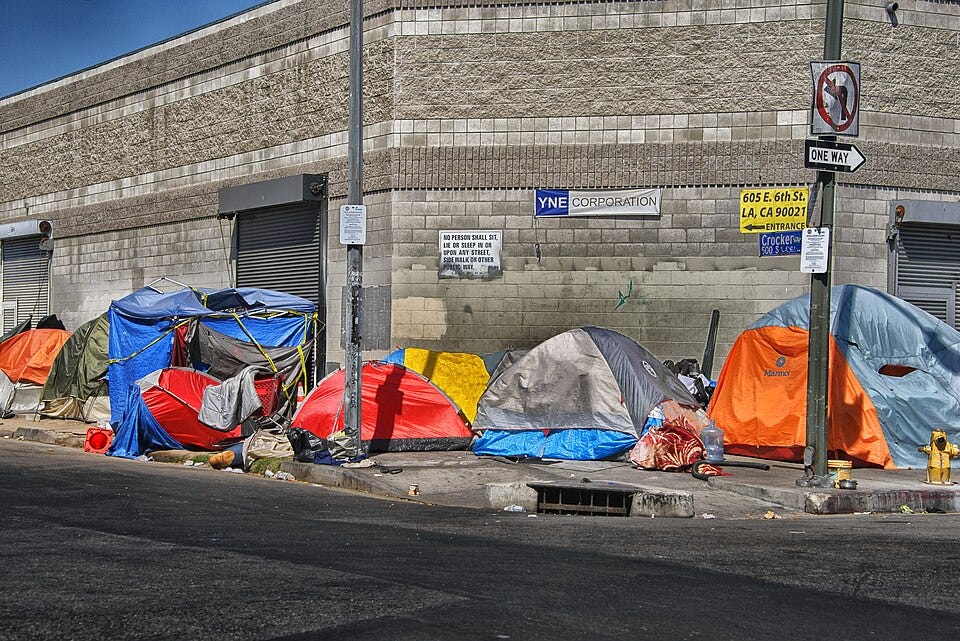
And nowhere is that failure more glaring than in Pacific Palisades. After devastating fires reduced entire neighborhoods to ash, what should have followed was urgency — debris cleared, permits expedited, rebuilding underway, families given a clear path home.
Instead, what too many residents see is the same disease plaguing modern urban governance: bureaucracy, delay, red tape, and political paralysis. Months pass, and too much still feels frozen in place. For families who lost everything, that’s more than incompetence — it’s abandonment.
Spencer Pratt’s larger point lands here with force: government is quick to regulate, quick to tax, quick to lecture — but painfully slow when it comes time to actually deliver for its citizens. Americans should not accept a system where disaster strikes, promises are made, and rebuilding stalls in a maze of excuses.
Pratt’s message cuts through because it’s simple: You do not have to live like this.
That’s a direct challenge to the modern progressive sales pitch — the idea that urban collapse is somehow normal, unavoidable, or merely the price of “compassionate policy.” Pratt is flipping that narrative on its head. He’s asking the question millions quietly ask every day: Why are Americans accepting conditions that would be unacceptable anywhere else?
From a law enforcement perspective, this matters.
Cities do not slide into disorder overnight. They decay when leadership loses the will to enforce standards. When quality-of-life crimes are ignored. When public disorder becomes background noise. When officials confuse permissiveness with compassion. When taxpayers are told to tolerate filth, disorder, and dysfunction while paying ever-higher taxes for ever-worsening services. Broken windows become broken neighborhoods. Broken neighborhoods become broken cities.
Don’t believe this is resonating? In L.A. and other blue cities and states? Look at this:

Just wait until this exodus hits the 2030 census.
What Pratt is doing — intentionally or not — is documenting that civic surrender in real time. Not through polished talking points. Not through ideological jargon. Through blunt, visual truth.
That’s why it resonates. Because while the far left uses social media to promise revolution, Pratt is using it to expose results.
And the result is this: Americans are looking at once-great cities and realizing decline is not inevitable — it’s a choice made by leaders, tolerated by voters, and sustained by silence.
Pratt isn’t selling fantasy.
He’s holding up a mirror.
And for a lot of people, what they see in that reflection is unacceptable. The citizens of Los Angeles are being thrown a lifeline. Are they fed up enough to take it or will they continue to let their once beautiful city die?
Weekly Pod
Friends, tune in tomorrow for a special guest on our weekly pod…. We could only get him tomorrow — he’s a name!
We’ll see you then…. This is going to be great fun.
And finally…
If you’ve ever wondered where these safety-hating voters came from… wonder no more:
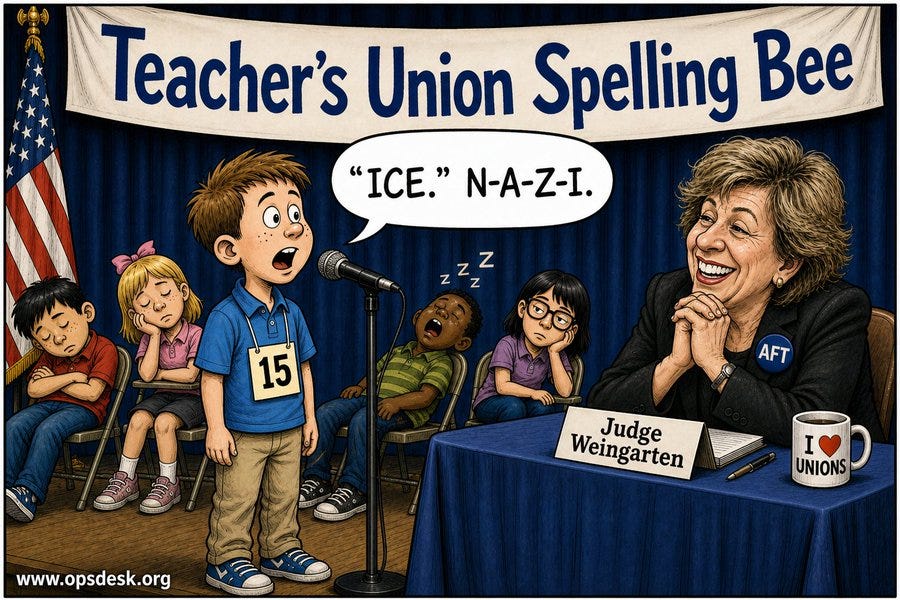
With today’s schools, we’d actually be surprised if the kid could spell “Nazi” right.

Trump Derangement Syndrome has become a death cult for public safety. If Trump says secure the border, the left opens the gates. If Trump says jail violent criminals, they scream decarceration. If Trump says dangerously mentally ill people should not be loose on subway platforms, they call that oppression. Then innocent people die, and the same politicians mumble about “systems.” No. This is ideology killing citizens. Public safety is the government’s first duty. Democrats turned opposition to Trump into opposition to order itself. The bodies are not accidents. They are the predictable costs of Democrat Party policies that protect criminals before victims.
I've been marveling at the videos that Pratt has made. Simply marvelous.
BTW, I enjoyed watching the movie recommendation from a week ago, however, I couldn't get through City on Fire.
Thanks for all you do!